
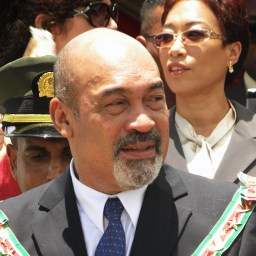
Like Father, Like Son?
Facing drug trafficking charges in the Netherlands, the president of Suriname may find a way to forestall his arraignment.
Facing drug trafficking charges in the Netherlands, the president of Suriname may find a way to forestall his arraignment.
Amidst an American-led investigation probing allegations of war crimes, the government of Sri Lanka has arrested two human-rights activists, prompting even more international disapproval.
Continue reading Sri Lanka Raises Suspicion Not Long Before UN Investigation
Amid efforts to locate the disappeared Malaysia Airlines flight MH370, tensions have developed between some countries involved in the search.
Continue reading The Mystery of MH370 and its International Implications
Over the past few days Israel has conducted multiple unprovoked airstrikes against Syria, including on the capital of Damascus. Though both the Israeli and U.S. governments have refused to officially acknowledge the attacks, the purported pretext has been widely reported.
Today across the globe there are approximately 300,000 children armed with AK-47s and hand grenades participating in domestic conflicts. Although these conflicts occur in developing nations in South America and Asia, they are often focused in Africa, and today in particular, in the Central African Republic. This rapid mobilization of child soldiers has been alarming for the international community as it tries to reconcile this new threat and the ratification of treaties and peace accords that delineate expectations for the rights and protection of children around the world.
After more than three years of dismal economic news regarding the Greek crisis, some are beginning to see a light at the end of the tunnel. Prime Minister Antonis Samaras’s coalition government has cohered remarkably well after the political paralysis in the months preceding his 2012 swearing-in, despite fierce competition between the New Democracy majority and radical leftist opposition party, Syriza. This relative stability appears to have inspired the confidence of the Troika, who gave Athens a “thumbs up” in their first progress report since releasing fresh aid in December to avoid bankruptcy.
The U.S. is investigating accusations that the Syrian government has used chemical weapons on its own civilians to quell their uprisings. As ever there is no unified consensus, which has led to the Syrian government denying the U.S.’s accusations and “likening them to false accusations that Iraq possessed weapons of mass destruction.” These Syrian officials attest that the U.S. would utilize such lies for an invasion similar to the Iraq invasion in 2004. It is true that U.S. officials have noted that if evidence surfaces confirming Syria’s use of chemical weapons then it would be a “game changer” and “all options [would then be] available.” The Syrian government fears that such tidbits foreshadow U.S. intervention.
Continue reading Why the U.S. Won’t Do Anything About Syria, And Why That Is Good
Motives for the violent Western intervention in Syria — where since at least early 2012 the CIA has been sending large shipments of weapons to Sunni militants working with al-Qaida front Jabhat al-Nusra — predictably appear rooted in geostrategic, rather than humanitarian, interests. Iran recently secured a $10 billion pipeline deal with Syria and Iraq that the U.S. and its European allies bitterly opposed. The project would bring Iranian hydrocarbons to the Mediterranean as well as Russia, which has sought to expand its influence in the region’s energy development.
In a nation where nearly 45% of the population lives in one city—the capital, Ulan Bator—those who reside elsewhere in the vast reaches of the landlocked state of Mongolia have long been isolated from the trappings of modern life. However, in recent years, as the economic development and technological advancement that has long been a … Continue reading Mining for Opportunity in Mongolia


 diplomacist.com